Main Content
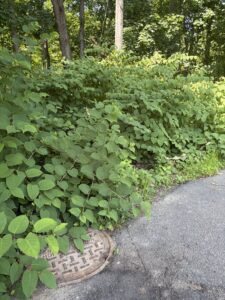
Invasive knotweed can reproduce underground through horizontal roots and adapt to a wide range of habitats, making it among the most difficult invasive plants to eradicate.

July 16, 2026 by Trish Maguire and Michele Bakacs
Invasive knotweed can reproduce underground through horizontal roots and adapt to a wide range of habitats, making it among the most difficult invasive plants to eradicate.

May 15, 2026 by Trish Maguire and Michele Bakacs
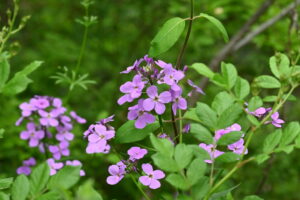
Is the “Invasive Species Spotlight” useful to you? Let us know how. Hesperis matronalis Dame’s Rocket (Hesperis matronalis) is a 2-3 foot tall flowering biennial often found along moist roadsides and wooded areas. Its erect, multi-stemmed structure and purple/pink flowers resemble native eastern blue phlox (Phlox divaricata) and therefore often misidentified as native. Dame’s rocket was introduced to the US in the 1600’s as a garden plant; however, its success invading the wild is largely due to its popularity in commercial […]

September 29, 2025 by Jean Epiphan and Phaedra Singelis
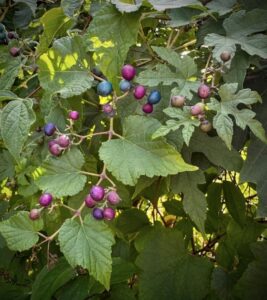
Is the “Invasive Species of the Month” useful to you? Let us know how. Ampelopsis glandulosa var. brevipedunculata synonym Ampelopsis brevipedunculata Porcelainberry, also known as Amur peppervine, (Ampelopsis glandulosa var. brevipedunculata) is a fast-growing, woody, deciduous vine (liana) that easily blankets any object or vegetation, smothering trees, shrubs, vines, herbaceous plants, and even other invasive plants. […]

May 9, 2025 by Michele Bakacs and Jean Epiphan
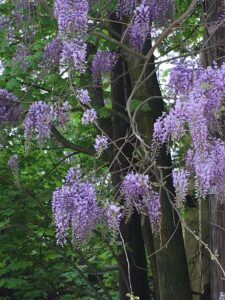
Invasive vines such as Wisteria spp. can kill healthy, mature trees. Simple actions like controlling invasive vines can help save trees, which are vital for capturing greenhouse gases and reducing the impact of climate change.

November 22, 2024 by Michele Bakacs
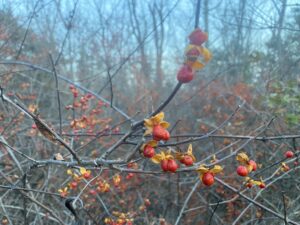
Round-leaved bittersweet, Celastrus orbiculatus, is an invasive vine that climbs, strangles, and smothers live trees.

July 10, 2024 by Michele Bakacs
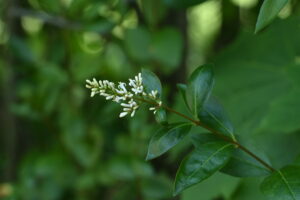
Privet, Ligustrum species, is an invasive, flowering, deciduous shrub. Various privet species are commonly used as hedges in residential and commercial landscapes. Some privet species have spread into understory forests and roadsides and are considered invasive plants in New Jersey.

March 28, 2024 by Michele Bakacs
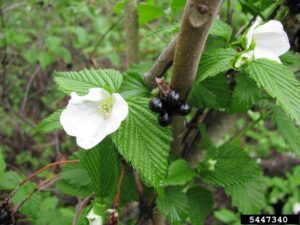
Jetbead, Rhodotypos scandens Jetbead is an invasive spring flowering, deciduous shrub. It is available as an ornamental and spreads into understory forests and roadsides. Its attractive white flower starts blooming in April making it easy to identify this time of year. Jetbead can grow in both full sun and shade. Due to its tolerance of […]

December 21, 2023 by Michele Bakacs and Jean Epiphan
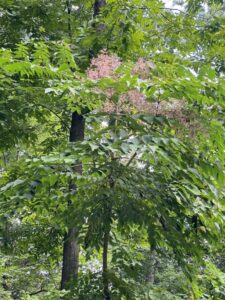
December Angelica Tree Aralia elata Japanese angelica tree (Aralia elata) is an extremely aggressive, fast growing, deciduous tree that invades forest canopy gaps, forest edges, and right of ways. It is a heavy seed producer and once this tree invades an area it takes over quickly, forming dense stands (Figure 1) and suppressing native vegetation […]

October 23, 2023 by Michele Bakacs
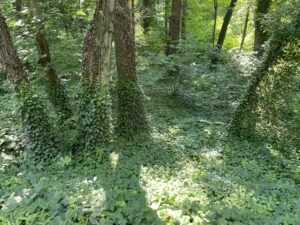
October English ivy (Hedera helix) Invasive vines such as English ivy can kill healthy, mature trees. Simple actions like controlling invasive vines can help save trees which are vital for capturing greenhouse gases and reducing the impact of climate change. Ecological threat: English ivy (Hedera helix) is an ornamental vine commonly planted in landscapes as a […]

September 21, 2023 by Michele Bakacs
Linden viburnum (Viburnum dilatatum) is an ornamental shrub commonly planted in landscapes, Linden viburnum invades the understory of forests and thrives in the shade. Be on the lookout for Linden viburnum’s bright red cluster of fruit in the fall persisting into December. This invasive shrub has creamy white flowers in clusters in the spring.